
Your strategy exists, but it’s not part of decisions.
Your people, and now their AI tools, make hundreds of small decisions every day. Most of them are made without your strategy in mind.
The Rotor Beta fixes that for one team first, so you can see whether it works before you commit to more. In plain terms:
I work with your leadership team to make the strategy specific. One clear priority, the trade-offs you'll accept, and the assumptions your plan rests on, all agreed and written down.
I put that strategy where decisions happen. A short video from you, a one-page visual, and your team's AI tools set up to work from it.
One team uses it for a full quarter. We measure whether their decisions become more consistent, compared with a team that doesn't use it.
You decide what's next. Scale it, adjust it or stop, based on the results.
The rest of this page covers the practical details: time, cost, deliverables, measurement and data. The thinking behind it comes at the end.
At A glance
About 18 weeks: 5–6 weeks to build, 12 weeks live, then a review
Length
Who’s Involved
The CEO, the leadership team, one pilot team and one comparison team
Works with ChatGPT, Claude, Microsoft Copilot or your LLM of choice. The basic setup needs no software. Advanced setups require integration with corporate IT.
Fixed, agreed before work starts.
Fee
Tools
Fits With
EOS, Scaling Up, OKRs or your own planning process
| Phase | Length | What happens | Output |
|---|---|---|---|
| Build | 5–6 weeks | Leadership interviews. Review of your existing strategy documents. One working session to set the main effort, trade-off rules and key assumptions. CEO video recorded. AI tools set up and tested with leadership. Baseline measures taken. | Rotor Sheet, one-page visual, strategy video, AI setup, baseline |
| Live run | 12 weeks | The pilot team uses the strategy and AI guidance in normal work. Check-ins at weeks 4 and 8. | Check-in notes and a decision log |
| Review | End of the quarter | Measures repeated and compared with the baseline and the comparison team. First quarterly review of the assumptions. | Results report and a recommendation: scale, adjust or stop |
The Three Phases
| Who | Build (5–6 weeks) | Live run (12 weeks) | Review |
|---|---|---|---|
| CEO | One interview, one working session, video recording | Check-ins at weeks 4 and 8 | Review meeting |
| Leadership team | One interview each and one working session | None required | Review meeting |
| Pilot team | Baseline decision cases | Normal work, using the strategy and their AI tools | Repeat the decision cases |
| Comparison team | Baseline decision cases | No change | Repeat the decision cases |
| IT | Help connect the AI tools | None | None |
Time Required
What You Receive
How results are measured
We report measures that can change within one quarter. We do not promise financial results. Those are written down as hypotheses at the start and tracked in later quarterly reviews.
Decision consistency (a noise audit). Before and after the live run, the pilot and comparison teams answer the same set of realistic decision cases. We compare how far apart their answers are. For reference: in an insurance company studied in Noise (Kahneman, Sibony and Sunstein, 2021), executives expected their underwriters' prices for the same case to differ by about 10%. The actual difference was about 55%.
Supporting measures
Leadership agreement on the main effort
Unprompted recall of the priorities
Time spent compared with stated priorities
Decision speed
Early warning signals from the assumption tripwires (advanced integrations)
Logged decisions that the guidance changed (advanced integrations)
If it doesn't work
At the review you decide whether to scale, adjust or stop. There is no obligation to continue. You keep the Rotor Sheet, the visualizations and the video.
Your data
Your strategy stays in AI tools your company already uses, under your existing agreements with those vendors.
Franklin Kinetics does not host your strategy data.
Everyone in the company can see the strategy the AI works from and a plain-language summary of how it behaves.
Results are reported by team, not by individual.
Why it works
| Deliverable | What it is |
|---|---|
| Rotor Sheet | The main effort, 5–7 trade-off rules with worked examples, 8–12 key assumptions with warning signs, a capacity target, and key terms in your company's own language |
| One-page visual | The Rotor Sheet as a graphic for meetings and onboarding |
| Strategy video | 2–3 minutes, narrated by the CEO |
| AI setup | Your AI tools configured with the Rotor Core and your Rotor Sheet |
| Results report | Baseline and end-of-quarter measures, pilot team against comparison team |
| Recommendation | Scale, adjust or stop, with the evidence behind it |
Commander's intent
Militaries learned long ago that they can't control every decision. Once a plan meets reality, the people closest to the problem have to act on their own, often with no one senior to ask.
Their answer is commander's intent: a short, clear statement of what the mission is for and what matters most. With it, people can make the call in the moment. If the call isn't perfect, they can explain how they reasoned from the intent, and they aren't punished for using their judgment.
Business works the same way. The Rotor Sheet is your commander's intent, written down, and the AI tools help people reason back to it. If you want your people to act on their own, they need a strong sense of your intent. If you'd rather they wait for instructions, you don't need Rotor.
Rotor turns that principle into a working system, built on established strategy and decision research.
The Rotor Framework
Most companies don't lack effort. They lack a shared direction for it. When every team works hard toward a slightly different goal, the effort cancels out: projects stall, priorities compete for the same people, and the leader ends up settling disputes the strategy should have settled.
The Rotor Framework fixes that by giving everyone the same reference point: one main effort, clear rules for the common trade-offs, and the assumptions the plan depends on. With those in place, people can move quickly and still pull in the same direction, and leadership sees early when an assumption stops holding.
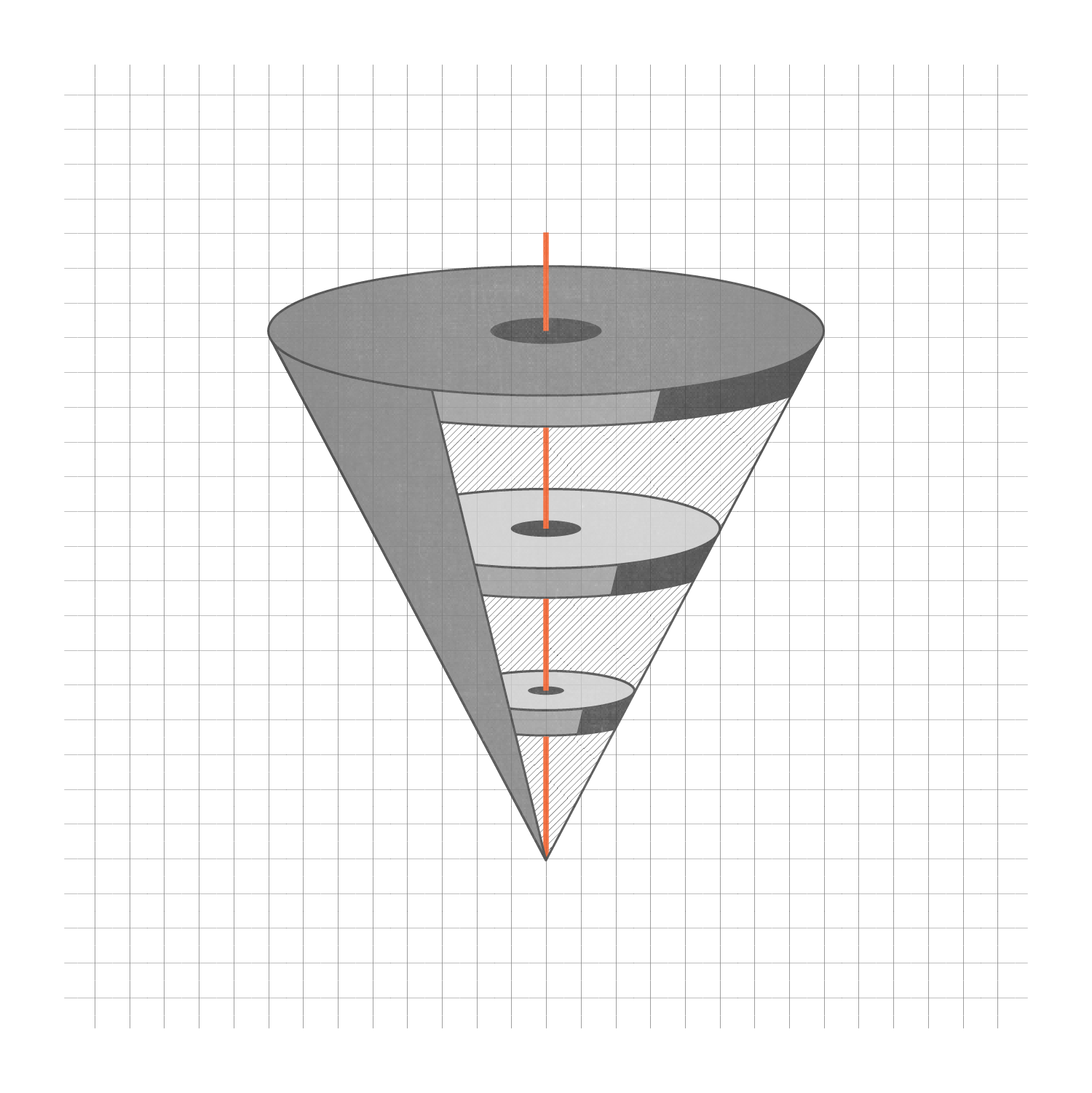
We picture it as a spinning top. While it turns around one axis, it stays upright. Lose the axis, or let friction build, and it starts to wobble.
That simplicity is deliberate. A few clear ideas and one memorable image make both the strategy and the way your organization actually moves easier for each person to remember. A forty-page plan is forgotten by Friday. A shared picture is still there when someone has to make a call on their own.
How the AI behaves
The same reference point goes into your AI tools. Every client's AI works from two things: the Rotor Core, a licensed set of reasoning models that is the same for every client, and your own Rotor Sheet. It is set up to:
ask questions rather than give instructions
assume the person knows more about their situation than it does
raise issues in proportion to the stakes
accept a decision once the person has made it
never steer covertly
Research behind it
None of this is new on its own. Rotor brings together well-tested work on strategy and decision-making:
Michael Porter: strategy means choosing what not to do.
Richard Rumelt: good strategy contains a guiding policy.
Kathleen Eisenhardt and Donald Sull: simple rules work better than detailed rulebooks in fast-moving markets.
Rita McGrath: treat plans as assumptions and test them.
Stephen Bungay: mission command applied to business.
Daniel Kahneman, Olivier Sibony and Cass Sunstein: professional judgments vary far more than organizations expect.
After the Beta
Quarterly reviews. A retainer to review the assumptions each quarter and update the Rotor Sheet.
Company-wide rollout. Extend the setup to every team.
Strategy debrief workshop (optional). A half-day session using public cases such as Mann Gulch, Tenerife and Air France 447 to examine how teams lose track of a changing situation.